
Golden Threads of Assam: Safeguarding Muga Silk and Rural Heritage in a Changing Climate
Dr. Monashree Sarma Bora,
Executive (Research), SDS
‘অসমীয়া শিপিনীয়ে তাঁতৰ শালত সপোন ৰচে।‘
(Assamese women weave dreams on their looms)
— Mahatma Gandhi
Assam possesses a rich heritage of weaving that has been intricately woven into its social and cultural fabric for centuries. Among the region’s textiles, endemic Muga (Antheraea assamensis) silk has long held a prominent position. Renowned for its natural golden sheen and exceptional durability, Muga silk represents the pride of Assam’s sericultural tradition. Historically, the patronage of the Ahom dynasty accelerated the development and prosperity of Muga silk rearing and weaving, embedding the industry deep within the socio-economic landscape of the region. Even today, Assam produces almost all of India’s Muga silk, a legacy recognized with a Geographical Indication (GI) tag in 2007.
Yet, beneath the shimmer of Muga silk, challenges have been growing in its cultivation. The number of families involved in Muga silk cultivation in Assam has dropped sharply in recent years, from nearly 60,000 a decade ago to just over 32,000, a sign of worry imprinted across rural Assam’s landscape. Most of these families are deeply attached to their craft, but they now face unpredictable climate patterns, market uncertainty, and mounting costs.
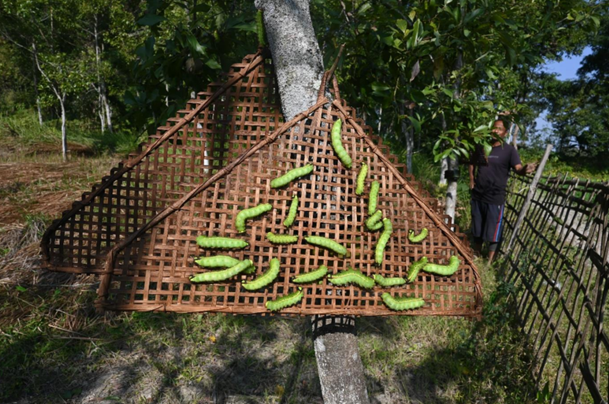
Climate-induced stresses, such as rising temperatures and erratic humidity, have emerged as key factors undermining stability across the entire Muga silk value chain. One of the foremost vulnerabilities is the limited availability of disease-free laying (DFL), the core input required for healthy cocoon production. According to government sources, institutional supply currently meets only approximately 20% of total seed demand, compelling farmers to rely on local seed sources that are substantially more expensive and biologically risk-prone. For instance, the price of seed cocoons has escalated to Rs. 25 per cocoon, far exceeding the official rate of Rs. 4 per cocoon. Farmers from Boko, Goalpara, and even Upper Assam are increasingly dependent on unauthorized seed grandeurs along the Assam-Meghalaya border, intensifying the demand-supply gap and introducing further instability into the value chain. Although the Directorate of Sericulture, Government of Assam, has established cocoon banks in locations such as Boko (Kamrup), Udalguri, North Lakhimpur, and Golaghat, the majority of cocoons are sold directly from the field, bypassing these centralized collection points and weakening their intended role in aggregating and stabilizing supply.
Climatic stresses have also adversely impacted the vitality of moths and also the leaf quality of host plants (Som and Soalu). The ideal temperature for Muga silkworm is 25–27°C. During critical summer months, temperatures often rise above 35°C, leading to significant declines in moth reproductive capacity. Healthy moths can lay 400–600 eggs, while those affected by environmental stress produce just 100–150. Such a decline contributes to diminished seed availability and crop yields. There has also been a surge in disease outbreaks, including Pebrine, Flacherie, and Muscardine, further diminishing productivity. Thus, these climatic challenges have driven Muga silk prices to levels exceeding Rs. 30,000 per kg (as of September 2025), affecting market accessibility, particularly for small-scale producers.
To address the above-mentioned temperature-induced seed viability issues, Central Silk Board (CSB) strategically relocates seed production during summer months (June to September), particularly for commercial crops (Jethua and Katia), to cooler sites in Mizoram, Kalimpong (West Bengal), Sikkim, and Nagaland. This adaptive approach improves seed quality but often restricts supply capacity, thereby perpetuating seasonal scarcity for farmers.
Amid these challenges, hope still threads its way through Assam’s sericulture. Farmers, weavers, and officials all recognize that innovation, group organization, and stronger market connections could help revive the sector. Climate-smart techniques, better seed banks, and sustainable farming methods could safeguard both livelihoods and tradition in a changing environment. There are also emerging opportunities, such as earning additional income from carbon trading by preserving host trees, connecting ancient practices with modern possibilities.
Ultimately, the fate of Assam’s Muga silk is more than an economic issue; it’s about honouring the rhythm of life that generations of Assamese families have woven into their future and finding new ways to keep their heritage alive under ever-changing skies.